
20 October 2026
FSSC 22000 Hibiscus Powder: Certified Color & Function at Industrial Scale
How to Qualify a Hibiscus Powder for Supply
Why hibiscus powder qualification stalls
Hibiscus powder is one of the most requested natural red ingredients in beverages and dry blends. It is also one of the hardest to qualify. Colour output can drift between harvests and suppliers, and documentation is often assembled only on request. For an R&D or procurement team, that means repeat sampling, reformulation and a qualification file that never quite closes.
Most of these problems surface late, in formulation trials. The fix is to ask the right questions earlier. The checklist below follows the four stages most EU food manufacturers already use to approve a new ingredient supplier. For each one, it covers what to request and what a credible supplier should be able to provide. We use Hubcycle's hibiscus powder as a worked example.
Stage 1 — Documentation review
Start with food safety certification, before any sample is ordered. Ask whether the ingredient is produced under a GFSI-recognised scheme such as FSSC 22000. FSSC 22000 certifies a food safety management system rather than a product. It is audited by a third party against ISO 22000, sector prerequisite programmes and additional scheme requirements.
What to request at this stage:
- The current certificate, with its scope and audit validity date
- The product specification sheet
- A regulatory compliance statement for the EU market, covering contaminant maximum levels for heavy metals, pesticide residues and mycotoxins
- A representative Certificate of Analysis (CoA) from a recent production lot
- A traceability summary describing how each lot is linked to its supply flow
Hubcycle's hibiscus powder is produced under an FSSC 22000-certified food safety management system and sourced from verified agro-industrial flows. The full dossier above is shared on first request, so the initial supplier risk assessment can start immediately.
Stage 2 — Sample and analytical verification
The sample should arrive with a CoA for its own lot, not a generic one. Hibiscus colour comes mainly from two anthocyanins: delphinidin-3-sambubioside and cyanidin-3-sambubioside. A specification-grade powder is defined by measured anthocyanin content, not by visual colour alone.
Check that the CoA reports at least:
- Total anthocyanin content and the reference used, typically cyanidin-3-glucoside equivalents
- Colour value and the measurement method
- Water activity and moisture
- pH in solution
- Particle size
- Microbiological status
Then check whether the supplier's methods match those of your lab or your third-party lab. When they do, supplier and buyer results can be compared directly, without disputes over method. Hubcycle defines its parameters against common third-party laboratory methods for this reason.
Stage 3 — Formulation trials and lot-to-lot consistency
A single good sample proves little. The real question is whether the specification window holds across commercial deliveries. Inter-lot drift is the main reason natural red ingredients get rejected after a successful first trial.
Two requests shorten this stage considerably:
- CoA data from several consecutive production lots. You can assess consistency statistically without placing several trial orders over months. Hubcycle provides multi-lot CoA data as part of its qualification package.
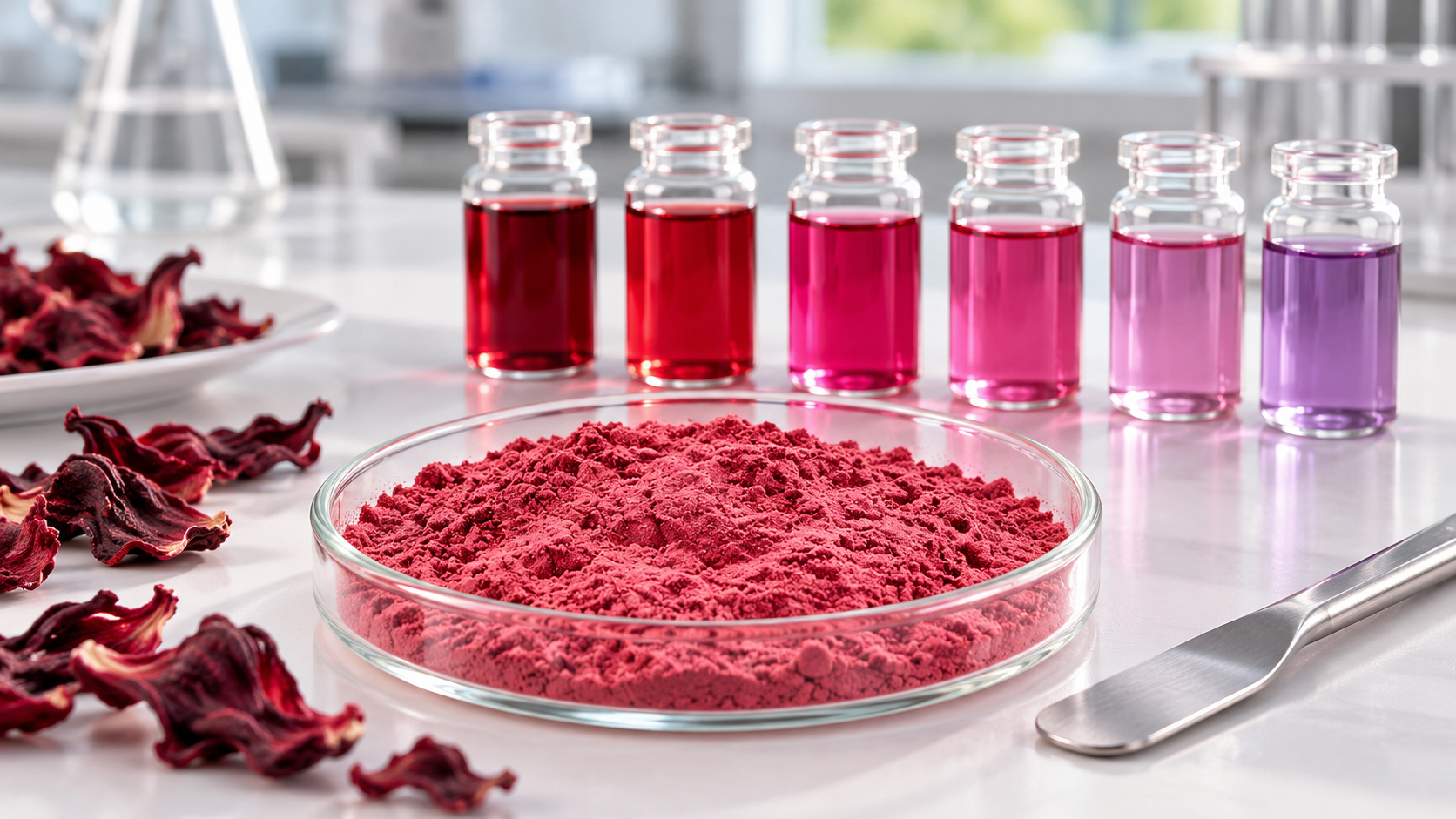
- Colour behaviour data across your pH range. Anthocyanins shift from red at low pH towards purple at neutral pH, and become less stable as pH rises. Knowing this curve before scale-up lets you set your acidulant and buffering strategy from the first trial.
If your application sits outside the acidic range, raise it now. It is better to adjust the brief at this stage than after a failed scale-up.
Stage 4 — Approved supplier registration and supply continuity
The last stage is administrative, but one risk is often missed: whether the supplier can follow you from pilot to full production. Changing hibiscus supplier mid-launch means requalifying from Stage 1.
Before registration, confirm:
- The annual volume available and how it is reserved
- Lead times for samples and for commercial orders
- Minimum order quantities
- Whether standing documents are updated automatically when they renew (certificate, compliance statement)
Hubcycle's hibiscus powder is available at up to 300 tonnes per year. Commercial volumes run on forward-order scheduling, so a qualification project can be sized for launch volumes from the start. Certification, compliance and traceability documents are maintained as standing documentation, ready to load into your approved supplier system.
Where hibiscus powder fits
Hibiscus powder performs best in acidic systems, where its red colour is most intense and most stable. As a finely milled calyx powder, it disperses in water rather than fully dissolving. That matters in clear beverages, where it may require filtration or a cloudy format.
Typical application fit:
- Beverages: ready-to-drink teas, flavoured and functional waters, soft drinks with an acidic profile
- Dry blends: powder sticks, instant drink mixes, tea and infusion blends, where fine particle size and controlled water activity allow direct incorporation
- Food matrices: fruit preparations, confectionery and coatings, where a natural red-to-pink colour and tart profile are wanted
For the full range of botanical ingredients, see our Functional Botanicals portfolio.
Start your qualification
Running a hibiscus powder qualification project? Request the technical dossier and a qualification sample. Our team will size volumes to your launch timeline from the start.
FAQ
It depends on how it is produced and used. A whole hibiscus powder used for its colour is generally treated as a colouring food. Anthocyanins selectively extracted for colour are an additive (E163). Your regulatory team should confirm the classification for your product and labelling.
La teneur en anthocyanes varie en fonction des conditions de récolte, de séchage et de broyage. Pour la maîtriser, il convient de spécifier la poudre en fonction de sa teneur mesurée en anthocyanes et de vérifier les données des certificats d'analyse (CoA) sur plusieurs lots.
Avec certaines limites. Au-delà d'un pH d'environ 4, la couleur vire vers le violet et devient moins stable. Les applications acides offrent les résultats les plus fiables.
Au minimum : un certificat de sécurité alimentaire reconnu par la GFSI, une fiche technique du produit, une déclaration de conformité européenne, un certificat d'analyse (CoA) spécifique au lot et un résumé de traçabilité.