08 October 2026
Supply Chain Diversification: How Certified Secondary Streams Reduce Climate Exposure
Volatility Has Become a Structural Feature of Ingredient Supply
For food manufacturers, climate risk is no longer a scenario in a sustainability report. It shows up in purchase prices, allocation letters and reformulation projects. In a recent FoodNavigator analysis of how supply chain resilience is reshaping food innovation, Chiara Cecchini, SVP of commercialization at Savor, summed up the new normal:
"You have El Niño, you have all these crises, and you see these prices going up and down, volatility really being part of the supply chain."
Her conclusion is the one that matters for procurement strategy: rather than positioning new ingredients as outright replacements, resilience comes from diversifying sourcing options. This article looks at what that means in practice — and why certified secondary streams are one of the most direct ways to build that diversification into an ingredient portfolio.
The Data Behind Climate-Driven Price Swings
The scale of recent shocks is well documented. A 2025 study in Environmental Research Letters (Kotz et al., summarised by Carbon Brief) linked specific extreme weather events to food price spikes since 2022:
- Cocoa up 280% between April 2023 and April 2024, following a West African heatwave.
- EU olive oil up 50% between January 2023 and January 2024, after drought in southern Europe.
- Coffee up 55% between August 2023 and August 2024, after drought in Brazil.
- Robusta up 100% between January and July 2024, after a heatwave in Vietnam.
What makes these markets hard to manage is not only the peaks but the swings. New York cocoa futures passed $12,000 per tonne in December 2024, then fell by roughly 70% towards $3,000 in early 2026, as Bakery&Snacks reported. Orange juice concentrate futures peaked at $5.43 per pound in December 2024 before dropping 69% by March 2026. A buyer who locked in at the top, or reformulated away from an ingredient just before it normalised, paid for volatility either way.
The outlook does not point to calmer markets. The FAO Food Price Index rose to 136.0 points in September 2026, up 5.8% year on year, with weather concerns cited across cereals, sugar and vegetable oils. Palm oil analysts are already flagging El Niño-driven dryness in Southeast Asia as a risk to 2027 production. And research by the Potsdam Institute and the European Central Bank estimates that rising temperatures could add 0.92 to 3.23 percentage points a year to food inflation by 2035.
Why Replacement Alone Does Not Reduce Exposure
Faced with a price shock, the instinctive response is substitution: reformulate away from the expensive ingredient. It is costly, slow and often reversible within a season. It also tends to move concentration risk rather than remove it — from one primary commodity to another that may be exposed to the same weather systems.
Procurement leaders are drawing the same conclusion. In McKinsey's December 2025 supply chain risk survey, 39% of companies reported pursuing dual sourcing. In Proxima's 2026 resilience outlook, reported by Food Manufacture, 51% of CEOs said their business could not operate for more than three weeks through a major supply shock, and 72% said they would accept supplier cost increases above 10% to secure resilience. Food manufacturing was singled out as particularly exposed to climate volatility.
Diversification works when the additional sources do not fail at the same time, for the same reason, as the primary one. That is where the structure of the source matters.
How Certified Secondary Streams Change the Risk Profile
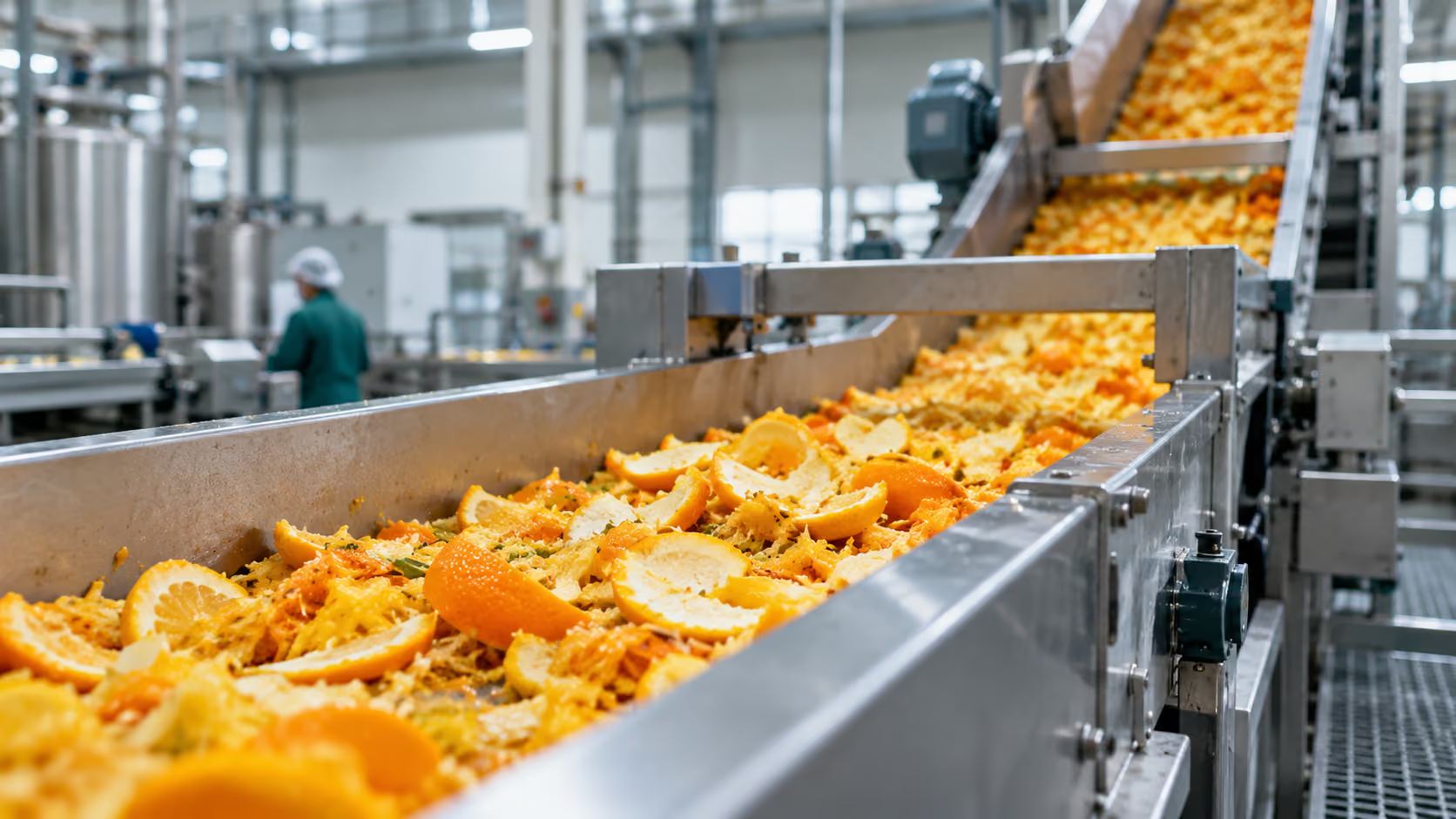
Certified secondary streams are high-value material flows generated within established food manufacturing operations, then qualified and supplied as ingredients in their own right. They are not immune to climate: a poor harvest eventually affects every stream that depends on it. But their risk profile differs from that of a primary commodity in three useful ways.
- Different exposure points. Secondary streams are aggregated from many processing sites across several regions, rather than from a single origin's harvest. Adding them to a portfolio spreads geographic and seasonal concentration.
- Partial decoupling from commodity pricing. Because these flows sit outside the primary agricultural commodity market, their price is driven by processing economics rather than by futures speculation on the next crop. That does not eliminate volatility, but it dampens how directly a weather headline reaches the purchase price.
- Existing industrial infrastructure. The material is already produced, handled and characterised inside food-grade operations. Scaling supply means contracting and qualifying flows that exist, not planting a new crop or building new capacity.
There is also a measurable environmental dividend. Hubcycle quantifies the impact of this sourcing model at 6.4 tonnes of CO₂ avoided per tonne of ingredient supplied, relative to primary production equivalents — a figure that supports Scope 3 reporting for customers who need it.
Certification Is What Makes Diversification Usable
An alternative source only reduces risk if it can enter the approved supplier list before the shock, not during it. That is why certification is the deciding factor. A secondary stream supplier that operates under FSSC 22000 / GFSI certification, issues a Certificate of Analysis on every lot and maintains lot-to-lot traceability can be qualified through the same process as any primary supplier — without a bespoke audit, and without asking quality teams to accept a lower standard.
The FoodNavigator analysis makes the same point from the market side: retailers act as gatekeepers for new sourcing options, and fragmented data across supply chains remains a persistent barrier to transparency. A diversification strategy that cannot produce origin, certification and batch-level quality data on request will stall at the listing review, however sound its logic.
Specification Consistency Turns a Second Source into a Usable Input
Certification answers the audit question; specification consistency answers the production question. An alternative ingredient whose functional profile drifts from lot to lot cannot be built into a scaled recipe, whatever its documentation. Secondary streams drawn from established industrial operations with stable, repeatable processes allow the relevant parameters — moisture, particle size, colour, polyphenol markers or fatty acid profile, depending on the ingredient — to be documented on every CoA and tracked against an agreed specification range over time. For R&D teams, that CoA series is the validation history that makes a second source formulation-ready.
The test is simple: same specification, same documentation, same audit readiness as the incumbent source. If a secondary stream meets that test, it becomes a genuine second source. If it does not, it remains an experiment.
A Practical Framework for Building a Diversified Ingredient Portfolio
- Map exposure by ingredient. Identify the ingredients where supply depends on one origin, one season or one weather system — the cocoa, coffee and olive oil profiles of the past three years are the reference cases.
- Find the qualifiable alternatives. For each exposed ingredient, list the certified sources that could meet the same specification, including secondary streams.
- Qualify before you need to. Run certificate verification, CoA review and an inter-lot consistency check while markets are calm, so a second source is ready to activate.
- Contract for optionality. Framework agreements with defined volumes from more than one qualified source protect both continuity and negotiating position.
Where Hubcycle Fits
Hubcycle supplies ingredients from alternative and audited supply, built on approximately 3,000 product references across seven categories: Spices & Herbs, Vanilla & Extracts, Juices & Concentrates, Fruits & Vegetables, Functional Botanicals, Bulk Flours and Fats & Oils. Operations run under FSSC 22000 / GFSI certification, with full traceability and specification documents on every shipment — so that an additional source can be qualified on the same terms as the incumbent one.
To map which ingredients in your portfolio could be dual-sourced, request a specification sheet or a sample from the Hubcycle commercial team.